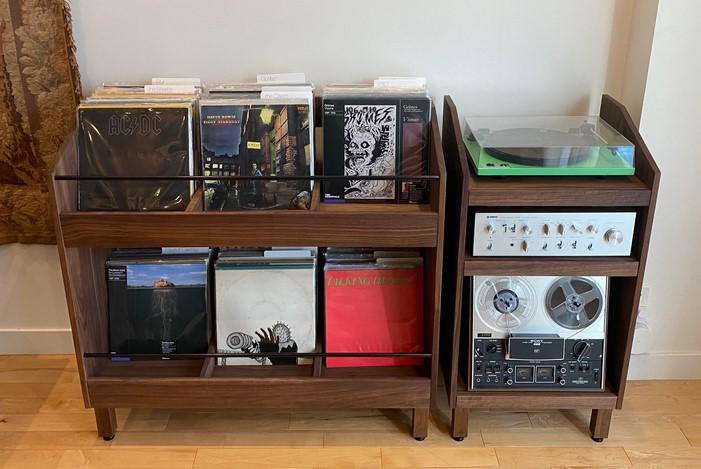
A client once invited me into his home to help build custom built-in shelving for his collection of over 1,500 vintage vinyl records. As I pulled a rare 1960s press off his old particle-board shelf to take measurements, my heart sank. The jacket was pristine, but the disc inside looked like a shallow soup bowl. He had stacked his records flat in horizontal piles five feet high, exerting hundreds of pounds of continuous crushing force on the bottom albums.
In a single afternoon, thousands of dollars in analog audio history and personal sentiment had been warped into useless plastic scrap.
Over my ten-plus years in home improvement and custom interior storage design, I have seen this tragedy far too often. Vinyl is not just a retro trend; it is a sensitive chemical polymer and a high-value physical asset. Protecting your collection requires moving beyond aesthetic display and mastering the technical mechanics of vinyl record storage.
The Physics of Polyvinyl Chloride: Why Storage Methods Matter
To understand why improper storage ruins analog media, you must understand the material science behind polyvinyl chloride (PVC). Think of a vinyl record like a solid slab of chocolate left in a warm car. At room temperature, it maintains a rigid shape, but under sustained physical pressure or elevated thermal conditions, its molecular bonds relax and shift.
The micro-grooves carrying your music are delicate physical landscapes measured in micrometers. When subjected to uneven pressure or improper angles, those microscopic ridges deform permanently, leading to tracking errors, surface noise, and unplayable warping.
-
Static Creep Deformation: Continuous physical pressure applied horizontally forces the soft PVC matrix to yield over time.
-
Thermal Expansion Strain: Fluctuations in temperature cause the vinyl compound to expand and contract, locking in warps if the disc is supported unevenly.
-
Chemical Off-Gassing: Standard PVC interacts negatively with cheap plastic sleeves, leeching plasticizers that create a milky, unremovable film across the micro-grooves.
Spatial Geometry: Vertical Orientation and Weight Distribution
The absolute cardinal rule of analog media preservation is simple: never store vinyl records horizontally.
WRONG: Horizontal Stacking (Crushing Force & Warping)
[====== RECORD 1 ======]  <-- Hundreds of lbs of pressure on bottom disc!
[====== RECORD 2 ======]
[====== RECORD 3 ======]

CORRECT: Strict Vertical Alignment (Zero Lateral Load)
 |  |  |  |  |  |  |     <-- Each disc carries only its own weight!
 |  |  |  |  |  |  |
Vertical placement ensures that each record bears only its own self-weight. However, achieving proper vertical alignment requires careful attention to load mechanics:
1. Vertical Angle Tolerances
Records must stand straight at a 90-degree angle to the shelf base. If records lean heavily at an angle exceeding 15 degrees, the gravitational load concentrates along the bottom edge, creating a slow, permanent dish warp over several months.
2. Shelf Load Calculations
Vinyl is surprisingly heavy. A standard 12-inch LP weighs roughly 0.4 to 0.6 pounds. A fully loaded 13-inch cube holding 100 records exerts nearly 60 pounds of concentrated static load on a single shelf span.
Always select solid hardwood, heavy-gauge steel, or high-density furniture-grade plywood rated for heavy dynamic loads rather than cheap hollow-core MDF.
Technical Specifications: Storage Parameters for Analog Media
Preserving physical media over decades requires managing three critical environmental metrics: load capacity, temperature, and relative humidity.
| Preservation Parameter | Target Optimal Range | Dangerous Failure Threshold | Structural / Material Risk |
| Ambient Temperature | 65°F to 70°F (18°C to 21°C) | Above 85°F (29°C) | Softens PVC compound; accelerates warping |
| Relative Humidity (RH) | 45% to 50% | Above 65% | Drives mold growth on paper jackets |
| Shelf Span Load Limit | Max 50 lbs per linear foot | Unreinforced MDF deflection | Shelf collapse; catastrophic jacket tearing |
| Inner Sleeve Material | High-Density Polyethylene (HDPE) | PVC / Polypropylene | Chemical fogging; micro-scratches |
Materials Science: Sleeves, Cubes, and Environmental Control
Building an effective vinyl record storage system requires layering physical protection around the media.
Inner Sleeves: Anti-Static Archival Protection
Throw away standard paper inner sleeves immediately. Paper sheds micro-fibers that lodge deep inside vinyl grooves and acts like sandpaper during extraction. Upgrade to archival HDPE (High-Density Polyethylene) sleeves lined with rice paper. They eliminate static buildup and shield micro-grooves from scuffs.
Outer Jackets: Polyethylene Barriers
Protect album jacket artwork from ring wear and edge splitting by slipping every record into a 3-mil to 4-mil thick polyethylene outer sleeve. Avoid tight PVC sleeves, which trap humidity and off-gas harmful chemicals over time.
Environmental Location Selection
Never position your collection near south-facing windows, external uninsulated walls, or HVAC supply vents. Direct UV exposure fades album art and rapidly heats dark vinyl through glass covers, causing severe heat-warping within hours.
Expert Advice: Pro Tips and Hidden Warnings from a 10-Year Pro
A decade of constructing media rooms and custom cabinetry yields critical insights that standard tutorials miss:
Pro Tip: The Vertical Divider Insert RuleWhen building or buying custom shelving for your vinyl record storage, install fixed vertical dividers every 4 to 6 inches along the shelf span. These dividers stop massive lean angles when pulling out albums, prevent domino-effect tipping, and distribute lateral load safely across the cabinet frame.
-
Hidden Warning #1: The Basement Moisture TrapStoring records directly on basement concrete floors or in unconditioned cellars is a recipe for disaster. Moisture migrates through porous concrete slabs, generating black mold spores inside paper jackets within weeks. Keep all storage units elevated at least 4 inches off the floor line.
-
Hidden Warning #2: Over-Packing the CrateSqueezing as many records as possible into a single cube creates extreme side-pressure. When you force records together too tightly, cardboard jackets rub against the vinyl surface, causing permanent “ring wear” grooves on the outer jacket faces. Leave roughly 2 inches of sliding clearance per shelf.
Step-by-Step Execution Plan for Your Storage Upgrade
Ready to safeguard your collection for the next generation? Follow this straightforward upgrade protocol:
-
Audit and Cull Damaged Sleeves: Remove all dusty paper inner sleeves and cheap plastic outer wraps.
-
Verify Shelf Structural Integrity: Check your shelving units for central beam deflection (bowing). Reinforce weak shelves with steel angle brackets or solid wood cleats.
-
Install Archival Liners: Re-sleeve every record into an anti-static HDPE inner sleeve, then place the jacket inside a 4-mil polyethylene outer cover.
-
Organize Vertically with Spacers: Arrange albums strictly vertically, using bookends or vertical shelf dividers every 5 inches to maintain a crisp 90-degree stance.
Protect Your Sonic Investment
Preserving physical media is an art form rooted in material science and smart spatial engineering. By choosing sturdy vertical shelving, maintaining ambient climate control, and insulating your collection with archival materials, you protect both the financial equity and emotional value of your record library.
How do you currently store your music collection at home? Are you dealing with cramped shelves, bowed cabinets, or climate control challenges? Drop a comment below or ask a question—I personally reply to help you build a safe, rock-solid home for your media!
