Imagine sitting in your living room on a quiet Tuesday evening when you hear a sound like a gunshot echoing through the house. It’s followed by a slow, agonizing groan of timber. You look up, and there’s a fresh hairline crack spider-webbing across your ceiling. This isn’t a scene from a horror movie; it’s the reality of structural overload.
A single cubic foot of wet snow can weigh up to 20 pounds. After a heavy storm, your roof might be supporting the equivalent of three full-sized SUVs parked on top of your shingles. In my 10 years of inspecting homes after winter storms, I’ve seen sturdy houses humbled by “white weight” simply because the homeowner didn’t have a plan.
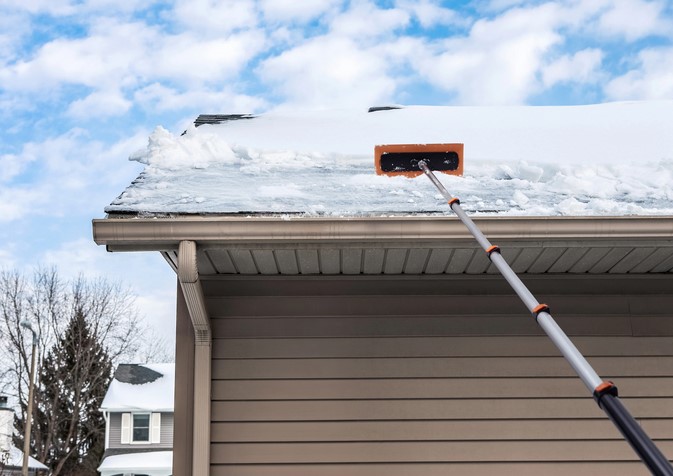
The solution isn’t to climb a slippery ladder with a shovel—that’s a recipe for a hospital visit. The solution is the surgical application of a Roof Rake Snow tool.
Why “Wait and See” is a Dangerous Roofing Strategy
Many homeowners believe that if their roof was built to code, it should handle anything nature throws at it. While true for average flurries, we are seeing more “unprecedented” weather events. As an expert, I look for the “Creep Factor”—the gradual deformation of roof trusses under sustained weight.
Think of your roof like a heavy-duty shelf. It can hold a lot, but if you leave a massive weight on it for weeks, the shelf starts to bow. Eventually, it won’t snap back into place. By using a Roof Rake Snow, you are essentially “unloading the shelf” before the permanent damage occurs.
The Ice Dam Connection
Beyond the weight, there is the silent killer: Ice Dams. When snow melts near the warm peak of your roof and refreezes at the cold eaves, it creates a reservoir of water that backs up under your shingles. Removing the bottom 4-6 feet of snow with a rake breaks this cycle, allowing your roof to “breathe” and drain properly.
Choosing Your Weapon: The Anatomy of a Roof Rake Snow Tool
Not all rakes are created equal. In my early days, I used a cheap, heavy steel rake that felt like I was deadlifting a car every time I reached for the eaves. Modern technology has changed the game.
1. The Head Design (Poly vs. Aluminum)
-
Polyethylene (Plastic): Lightweight and gentle on shingles. If you have an older roof with brittle granules, go with poly.
-
Aluminum: Heavier but cuts through “crusty” or frozen snow much better.
-
The “Roller” Innovation: Look for a Roof Rake Snow with small wheels or rollers on the head. These prevent the blade from scraping directly against the shingle surface, preserving your roof’s lifespan.
2. Pole Length and Material
You want a telescopic pole or a multi-section snap-fit system. Most standard homes need at least 20 feet of reach. Aluminum poles are the industry standard, but high-end fiberglass poles offer better electrical insulation—a literal lifesaver if you are working near power lines.
3. The “Snow Slide” Alternative
For those with physical limitations or extremely deep snow, there are “slide” systems. Instead of a rake head, these use a frame that slides under the snow, causing it to glide down a fabric ramp. It’s gravity-assisted efficiency at its finest.
The Technical Approach: How to Rake Without Ruining Your Roof
Using a Roof Rake Snow is an art form. If you just hack away at the snow, you’ll end up in my office asking for a $15,000 roof replacement.
The “Shave” Technique
Never try to scrape the roof clean down to the shingles. Your goal is to remove the bulk of the weight. Leave about 2-3 inches of snow behind. This thin layer acts as a protective buffer for your shingles against the rake’s edge.
The Directional Pull
Always work from the eaves (the bottom edge) upward. If you start high up, you are pushing thousands of pounds of snow onto the lower sections that are already under stress.
-
Step 1: Clear the overhangs.
-
Step 2: Clear the first 3 feet of the roof slope.
-
Step 3: Extend the pole and take small “bites” of snow, pulling them toward you in a controlled motion.
Professional Insights: What I’ve Learned in the Field
I’ve spent thousands of hours on jobsites, and here are the “insider” technicalities that the manuals leave out:
-
The Power Line Radius: Always look up before you extend that 20-foot aluminum pole. Aluminum is a fantastic conductor. If you touch a service drop line, the results are fatal. Stay at least 10 feet away from any wires.
-
The “Avalanche” Zone: When you pull snow down, it doesn’t just fall; it accelerates. I’ve seen homeowners get buried or have their porch railings crushed because they stood directly under the eave they were raking. Stand as far back as the pole allows.
-
Granule Loss Check: After you finish raking, look at the snow on the ground. If you see a heavy coating of “sand” (shingle granules), you are being too aggressive. Lighten your touch or check if your rake’s wheels are stuck.
Maintenance and Storage for Longevity
A high-quality Roof Rake Snow is an investment. Don’t throw it in a damp shed and forget it until next December.
-
Lubricate the Joints: Use a silicone-based spray on the push-button connectors. This prevents “cold-welding” where the metal sections seize together due to oxidation.
-
Check for Burrs: Inspect the edge of the rake head for any metal burrs or sharp nicks. A 1-inch metal burr can slice through a shingle like a hot knife through butter. Use a fine-grit file to smooth out any imperfections.
-
Tighten the Braces: Most rakes use a triangular bracing system. Ensure these bolts are snug; a wobbly rake head loses 40% of its cutting power.
Expert Advice: The “Invisible” Danger
Beware of the Asymmetric Load. I once visited a house where the owner had raked only the front half of the roof because “it looked better.” The massive weight on the back half, combined with the lack of weight on the front, put a twisting torque on the ridge beam that nearly collapsed the garage. If you start raking, do the whole perimeter evenly to keep the structural load balanced.
Summary: A Proactive Winter Legacy
The Roof Rake Snow is more than just a tool; it’s an insurance policy you hold in your hands. By understanding the physics of snow load and the mechanics of proper removal, you aren’t just cleaning your house—kamu sedang melindungi aset terbesarmu.
Don’t wait for the ceiling to groan. Taking the time to manage your roof’s stress level during the winter will save you from the “spring leak” nightmare that haunts so many homeowners.
Have you ever noticed your doors sticking or windows refusing to open after a big snowstorm? That’s your house “talking” to you about weight. Let me know your winter maintenance stories in the comments—I’m here to help you keep your structure sound!
