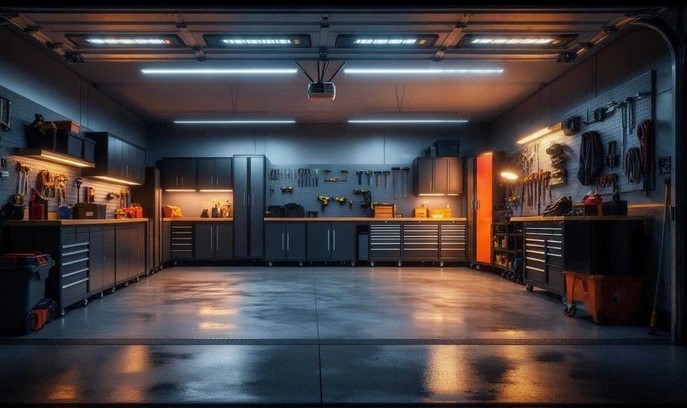
You’re standing in your garage at 8:00 PM, trying to find a 10mm socket that just vanished into thin air. You look up, and all you see is that lonely, flickering 60-watt incandescent bulb casting long, eerie shadows that make your workspace look more like a cave than a shop. It’s a classic scenario: we spend thousands on tools and flooring, yet we try to work in “stealth mode” because of poor visibility.
In my twelve years of retrofitting workshops and residential garages, I’ve seen more “close calls” with table saws and more botched paint jobs due to poor lighting than I care to admit. The truth is, your garage isn’t just a parking spot; it’s a high-stakes environment. Upgrading to a professional-grade Garage Lighting LED system isn’t just a cosmetic fix—it’s a massive upgrade to your safety, accuracy, and mental clarity.
Why Your Old Shop Lights Are Failing You
Most older garages rely on either outdated incandescent bulbs or those humming fluorescent tubes that take five minutes to “warm up” in the winter. As an expert who has climbed more ladders than I can count, I can tell you that the biggest enemy of a productive garage is Stroboscopic Effect and CRI (Color Rendering Index).
Old fluorescent lights flicker at a frequency that can actually make rotating machinery look like it’s standing still—a nightmare for safety. Furthermore, they often have a low CRI, meaning colors look “muddy.” If you’ve ever painted a project under bad lights only to realize it’s the wrong shade of blue once you pull it into the sunlight, you’ve experienced this frustration firsthand.
Understanding the “Lumen-Per-Square-Foot” Blueprint
When I walk into a client’s garage, the first thing I do isn’t looking at the fixtures; I look at the floor. To get professional-grade visibility, we need to talk about Lumens, not Watts.
Think of Lumens like water coming out of a sprinkler head. Watts is just how much electricity the pump uses. In a garage setting, you want a high “flow” of light. For a standard workspace, I recommend a target of 50 to 70 lumens per square foot.
-
Storage Only: 10-20 lumens per sq. ft.
-
General Parking/Walkway: 30-40 lumens per sq. ft.
-
Detailed Task Work (Woodworking/Auto): 70-100 lumens per sq. ft.
If you have a standard 20×20 foot two-car garage (400 sq. ft.), and you want to actually see what you’re doing, you’re looking for a total output of roughly 20,000 to 28,000 lumens.
Choosing the Right Garage Lighting LED Architecture
Not all LEDs are created equal. In the field, we generally categorize high-output systems into three main architectures:
1. Integrated LED Shop Lights (The “Linkable” Workhorse)
These are long, 4-foot or 8-foot fixtures where the LEDs are built directly into the housing. I prefer these for most “mid-level” users because they are linkable. You can plug one into the next, meaning you only need one outlet on the ceiling to power an entire row of lights.
2. Deformable “Trilight” Bulbs (The Easy Entry)
If you aren’t ready to rewire your ceiling, these screw into a standard E26 light socket but feature three or four adjustable “wings.” They are fantastic for concentrated light, but they are “point sources,” meaning they create sharper shadows than long tubes.
3. High-Bay UFO Lights
Usually reserved for ceilings higher than 12 feet, these look like small flying saucers. They throw a massive amount of light downward in a circular pattern. If you have a pole barn or a high-clearance garage, these are your best friend.
The Secret Sauce: Color Temperature (Kelvin)
This is where many people get it wrong. They buy “Warm White” bulbs because they want the garage to feel “cozy.” Stop right there.
In a workshop, you want light that mimics the high-noon sun. This is measured in Kelvins (K).
-
3000K (Warm): Great for a living room, terrible for a garage. It makes you sleepy and hides grease and grime.
-
4000K (Neutral): A safe “middle ground,” but still a bit soft for detail work.
-
5000K to 6000K (Daylight): This is the Sweet Spot. It’s crisp, bluish-white, and keeps your brain alert. It highlights imperfections in wood grain or car paint that you would otherwise miss.
Installation Tactics: Avoiding the “Swiss Cheese” Ceiling
I’ve seen plenty of DIYers turn their ceiling into Swiss cheese by drilling unnecessary holes. When installing Garage Lighting LED tubes, layout is everything.
The Perimeter Strategy: Don’t just put one big light in the center. Your car or your own body will cast a shadow over your workbench. Instead, mount lights in two parallel rows above the edges of where your vehicles park. This ensures light hits the sides of the car and the front of your tool chests.
Mounting Height Matters: If your lights are too low, you’ll get “hot spots” (blindingly bright areas). If they are too high, the light disperses too much. For 8-to-10-foot ceilings, flush-mounting or short 6-inch chains are usually the best bet.
💡 Pro Tip: The “Shadow Test”
Before you permanently mount your fixtures, use a temporary heavy-duty mounting tape or have a friend hold the light while you stand at your primary workbench. If you see your own shadow blocking your “work zone,” move the light 2 feet forward. High-output lighting is only effective if it reaches the tip of your screwdriver.
Hidden Warnings: The “RF Interference” Trap
Here is something you won’t find on the back of the box at a big-box store: Radio Frequency (RF) Interference.
Cheap, unshielded LED drivers (the “brains” inside the light) can emit electromagnetic interference. I’ve had clients call me complaining that their garage door opener stopped working or their radio is full of static as soon as they turn the lights on.
Expert Advice: Look for lights that are FCC Part 15 compliant. This ensures the electronics are shielded and won’t mess with your garage door remote or your Wi-Fi signals. Spending an extra $10 per fixture to avoid a non-functional garage door is a trade-off I’ll take every time.
Durability and Environmental Factors
Garages are harsh. They get dusty, they get humid, and in some regions, they get freezing.
-
IP Ratings: Look for an IP65 rating if you do a lot of pressure washing or live in a very humid climate. This means the fixture is “dust-tight” and protected against water jets.
-
Operating Temperature: Ensure your LED system is rated for “Cold Start.” Many cheap LEDs struggle to ignite or provide full brightness when the temperature drops below freezing.
Conclusion: Lighting as a Tool
We often view lighting as an afterthought—something we click on just so we don’t trip over the lawnmower. But after a decade in the home improvement industry, I view a high-output Garage Lighting LED system as the most important tool in the shed. You can’t fix what you can’t see, and you can’t be safe in the dark.
Upgrading your visibility changes the way you interact with your space. Suddenly, that cluttered corner looks manageable, and that complex engine repair seems doable. It’s about reclaiming your space from the shadows.
How is the visibility in your garage currently? Are you dealing with flickering tubes or dark corners that drive you crazy? Drop a comment below with your garage dimensions, and let’s figure out the perfect lumen count for your next project!
