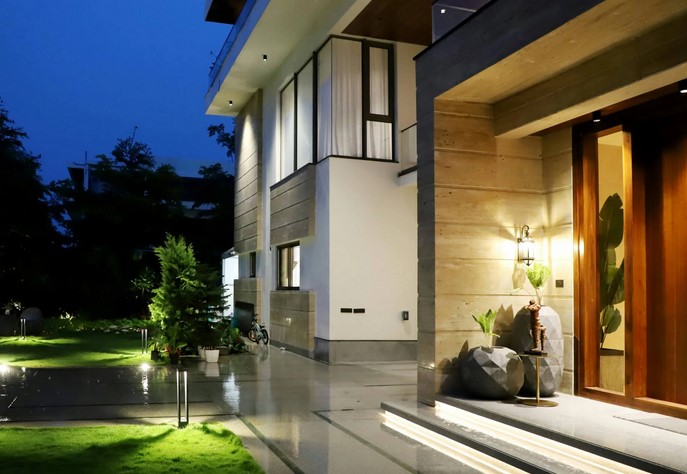
It’s 11:30 PM, you’re coming home with a trunk full of groceries, and as you approach your front door, you’re greeted by a pitch-black abyss. You fumbled with your keys for two minutes, feeling that primal prickle of unease on the back of your neck. Did you know that a well-lit home is significantly less likely to be targeted by intruders? Security isn’t just about high-tech cameras; it starts with the humble light fixture.
In my ten years of hardening homes against both the elements and unwanted visitors, I’ve seen homeowners drop thousands on “smart” security systems while leaving their side entries in total darkness. I always tell them the same thing: A camera is just a witness, but a well-placed Outdoor Wall Sconce is a deterrent. It’s the difference between seeing a blurry silhouette on your phone later and preventing the person from approaching in the first place.
The Dual Purpose of the Modern Sconce: Aesthetic vs. Armor
When most people think of a “sconce,” they think of a decorative lantern. But in the professional world, we view the Outdoor Wall Sconce as a tactical asset. It serves a dual purpose: Curb Appeal and Operational Security.
Think of your exterior lighting like a suit of armor. If there are gaps in the joints, that’s where the trouble gets in. Lighting “gaps” are those deep shadows near windows, back decks, and garage side-doors. A strategic layout of sconces fills those gaps, eliminating the hiding spots that make a home look vulnerable.
Beyond security, there is the undeniable “Wealth Effect.” A home that is bathed in warm, layered light looks expensive and well-maintained. Neglected lighting often signals a neglected home—and that’s an invitation no homeowner wants to send.
Decoding the Technical Specs: Lumens, IP Ratings, and Photometrics
If you’re a beginner, it’s easy to get distracted by a pretty finish like “Oil-Rubbed Bronze.” But as an expert who has had to replace rusted “bargain” lights after just one coastal winter, I need you to look at the data.
1. The IP Rating (Ingress Protection)
This is non-negotiable. An Outdoor Wall Sconce must be able to handle rain, dust, and insects. Look for an IP44 rating or higher.
-
The first digit (4) means it’s protected against solid objects larger than 1mm.
-
The second digit (4) means it’s protected against splashing water from all directions.
-
If you live in a high-wind or storm-prone area, I recommend jumping to IP65.
2. Lumens: The “Goldilocks” Zone
For security lighting, you don’t want a blinding searchlight that annoys your neighbors. You want “functional brightness.”
-
Front Door: 700–1,000 lumens.
-
Side/Back Entries: 400–700 lumens.
-
Ambient Accent Lighting: 200–300 lumens.
3. Color Temperature (Kelvin)
I’ve spent years experimenting with Kelvin scales. For security, people often think “the whiter, the better.” This is a myth. A harsh 6000K light creates deep, jagged shadows. I prefer 3000K (Warm White). It provides enough clarity to identify a face or a license plate but is warm enough to keep your home looking like a home, not a gas station.
Strategic Placement: Where to Mount for Maximum Impact
I often see sconces mounted way too high. If the light is 8 feet off the ground, it’s mostly lighting up your soffits and the tops of heads.
The Eye-Level Rule: For a standard front door, your Outdoor Wall Sconce should be mounted so the center of the light source is roughly 60 to 66 inches above the floor. This ensures the light hits the “lock zone” (where you put your key) and the “face zone” (so you can see who is at the door through your peephole).
The Proportionality Trick:
-
If you have one light, it should be about 1/3 the height of the door.
-
If you have two lights (one on each side), they can be slightly smaller, about 1/4 the height of the door.
Analogy: The “Shield” vs. The “Candle”
To explain light distribution to my clients, I use the “Shield and Candle” analogy.
-
The Candle (Diffused): These are sconces with clear or frosted glass that throw light in every direction. Great for porches where you want to see everyone’s face clearly.
-
The Shield (Dark-Sky Compliant): These are “downlight” fixtures where the bulb is hidden under a metal cap. These act like a shield, pushing light directly onto the ground.
For security, the “Shield” is often superior because it creates a high-contrast pool of light on the floor, making it impossible for someone to crouch near your foundation without being seen.
Expert Advice: Enhancing Security with Automation
You can have the most expensive Outdoor Wall Sconce in the world, but if you forget to turn it on, it’s just a piece of metal on your wall.
-
Dusk-to-Dawn Sensors (Photocells): These are my favorite “set it and forget it” upgrades. They automatically turn the light on when the sun goes down.
-
Dual-Level Dimming: This is an “insider” secret. These lights stay at a low, elegant 20% brightness all night (the aesthetic) but snap to 100% brightness if they detect motion (the security). It’s a sophisticated way to tell a prowler, “I see you,” without keeping your neighbors awake with a constant floodlight.
⚠️ The “Ghosting” Effect
If you are using LED bulbs in an old fixture with a cheap motion sensor, you might experience “ghosting”—where the light stays dimly lit even when turned off. This happens because some sensors leak a tiny bit of current. Always ensure your sconce and its sensor are “LED Compatible” to avoid wasting energy and burning out your bulbs prematurely.
Materials That Last: Why “Cheap” is Expensive
I’ve seen plastic sconces fade to a sickly gray in two years and “stainless steel” fixtures that are covered in tea-staining (rust) after one season.
If you want your investment to last a decade, look for Cast Aluminum with a high-quality powder coating or Solid Brass. These materials can withstand the constant UV pounding and the expansion/contraction of temperature shifts. In my professional opinion, spending $50 more upfront on a cast-metal fixture saves you $200 in replacement costs and labor five years down the road.
Conclusion: Lighting the Path Forward
Modernizing your home’s exterior isn’t just about picking a style you saw in a magazine; it’s about creating an environment where you feel safe and in control. A well-chosen Outdoor Wall Sconce is a silent sentry. It welcomes your friends, warns your enemies, and ensures that you never have to fumbled for your keys in the dark again.
Remember, security is layered. Start with the light, then move to the locks, then the cameras. But never underestimate the power of a well-lit doorway to change the entire energy of your property.
Is your home currently protected by shadows or light? I’d love to hear about your current exterior setup. Are you dealing with rusted fixtures or dim bulbs? Comment below with your home’s style, and let’s talk about which sconce layout would work best for your security needs!
