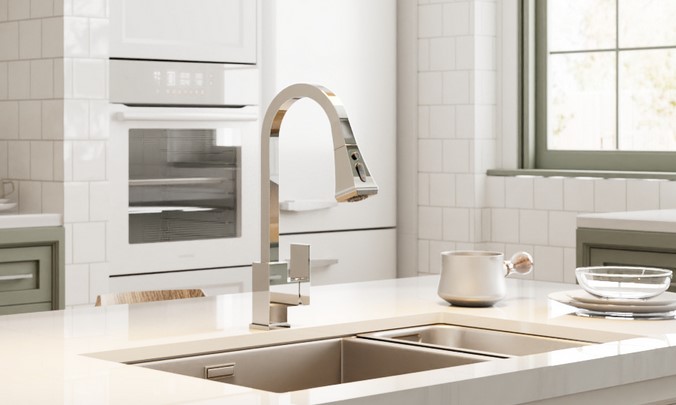
Imagine standing in your kitchen after a long, chaotic day. You reach out to wash a piece of fruit, and instead of a harsh, splashing jet of water that bounces off the sink and soaks your shirt, you are met with a wide, laminar flow that cascades like a mountain stream. The sound is hushed, the movement is fluid, and for a brief second, your kitchen feels less like a workspace and more like a high-end spa.
In my ten years of tearing out dated plumbing and installing the future of home design, I’ve seen the kitchen transition from a purely functional “engine room” to the aesthetic heart of the home. We’ve moved past the era where a faucet was just a bent pipe with a valve. Today, the Waterfall Sink Faucet has emerged as the ultimate statement piece for homeowners who want to merge industrial efficiency with organic beauty. I’ve personally installed hundreds of these, and the reaction is always the same: it’s the one upgrade that guests notice before they even see the countertops.
The Physics of the Flow: Why Waterfall Design is Different
To understand the appeal of the Waterfall Sink Faucet, you have to understand the difference in water delivery. Traditional faucets use an aerator—a tiny screen that mixes air with water to create a pressurized stream. It’s effective, but it’s “noisy” both visually and acoustically.
Think of a traditional faucet like a fire hose nozzle—concentrated and aggressive. A waterfall faucet, by contrast, is like a spillway on a dam. It utilizes a wide, open-channel spout that allows water to flow naturally under its own weight after being delivered to the manifold. This creates a “laminar flow,” where the water molecules move in parallel paths without turbulence.
From a technical standpoint, this design requires a specific internal ceramic disc cartridge to manage the flow without the backpressure typically provided by an aerator. When you turn that handle, you aren’t just opening a valve; you are directing a controlled architectural element.
Strategic Selection: Choosing Your Waterfall Sink Faucet
For the beginner and intermediate DIYer, not every waterfall design is created equal. When I consult on a kitchen remodel, I look at three critical data points: Material Integrity, Spout Reach, and Valve Durability.
1. Material and Finish
Most high-end waterfall faucets are crafted from Solid Brass. Why? Because brass resists the corrosive nature of hard water better than almost any other alloy.
-
The Insight: If you see a faucet that feels suspiciously light, it’s likely zinc or plastic with a metallic coating. In a waterfall design, where water sits in an open channel, a cheap finish will “pit” and peel within six months. Always opt for PVD (Physical Vapor Deposition) finishes, which are molecularly bonded to the metal.
2. Spout Geometry and Clearance
Because the water “falls” rather than “shoots,” the height of the spout (the Deck to Outlet height) is vital.
-
The Constraint: If the spout is too high, you get excessive splashing despite the gentle flow. If it’s too low, you can’t fit a large pasta pot underneath. I generally recommend a clearance of at least 8 to 10 inches for a primary kitchen basin.
3. Single-Handle vs. Dual-Handle
Most Waterfall Sink Faucet designs utilize a single-handle lever. This is for more than just aesthetics; it allows for precision temperature scaling. By moving one lever, you can find that “sweet spot” of warmth without fumbling with two separate valves while your hands are covered in flour.
Technical Deep-Dive: Installation and Water Pressure
Installing a waterfall faucet isn’t significantly harder than a standard one, but it is more sensitive to your home’s “plumbing health.” In my decade of experience, I’ve found that the “Waterfall Effect” is highly dependent on your Static Water Pressure.
-
Pressure Management: If your home has low pressure (below 40 PSI), the “waterfall” might look more like a “leaky faucet.” Conversely, if your pressure is too high (above 80 PSI), the water will overshoot the sink basin.
-
The Supply Lines: I always use stainless steel braided hoses with a 3/8-inch compression fitting. Avoid the old-school rigid copper supply lines; they don’t allow for the slight adjustments needed to center a wide-spout faucet perfectly over the drain.
Improving Facility Performance: The Maintenance Protocol
One of the “hidden” truths about the Waterfall Sink Faucet is that it requires a different maintenance mindset. Because the spout is open to the air, minerals in your water (calcium and magnesium) have a place to settle and dry.
-
The Vinegar Flush: Once a month, I tell my clients to dampen a microfiber cloth with a 50/50 mix of water and natural cleaning vinegar and lay it across the open channel. This dissolves “white crust” (limescale) before it can ruin the laminar flow.
-
Debris Monitoring: Since there is no aerator screen to catch sediment from your water heater, small pebbles can occasionally mar the flow. Always ensure your “shut-off valves” under the sink have built-in filters to protect the ceramic cartridge.
Tips Pro: The “Splash” Warning
Most waterfall faucets are designed for “vessel” style or deep-undermount sinks. If you install a wide-flow waterfall faucet over a shallow, stainless steel drop-in sink, you will get splashing. The water hits the flat bottom with more surface area than a standard stream. Always pair this faucet with a sink that has at least 9 inches of depth and a centered or rear-offset drain.
Scannable Checklist for a Waterfall Upgrade:
-
Check the Hole Configuration: Is your sink a 1-hole or 3-hole? Most waterfall designs are 1-hole. You may need a “deck plate” (escutcheon) to cover extra holes.
-
Measure the Reach: Ensure the water falls into the drain or just slightly behind it.
-
Verify Valve Quality: Look for “Ceramic Disc Valve” in the specs—this prevents the dreaded “drip-drip-drip.”
-
Consider the Sound: Laminar flow is quieter, but if the water falls from a great height, it creates a “drumming” sound on metal sinks.
Analogy: The “Gentle Rain” Philosophy
Think of a traditional faucet like a pressure washer used on a delicate flower. It gets the job done, but it’s aggressive and chaotic. The Waterfall Sink Faucet is the gentle rain. It provides the same volume of water but delivers it with a surface tension that holds the stream together. It’s about moving from “forcing” the water to “inviting” the water into your space.
Incorporating a Waterfall Sink Faucet into your kitchen design is more than an aesthetic choice; it’s an investment in the “tactile experience” of your home. It’s about taking a mundane, 50-times-a-day task and turning it into a moment of sensory pleasure. By selecting high-quality materials and respecting the technical requirements of water pressure and sink depth, you elevate your kitchen from a mere facility to a masterclass in modern architectural texturing.
Don’t settle for the “standard” when the “extraordinary” is just a plumbing swap away.
How does your current faucet feel? Is it a noisy neighbor or a silent partner in your culinary adventures? Drop a comment below—I’d love to help you determine if your current sink depth is the right match for a waterfall upgrade!


